FCL vs LCL in Sharjah: choose the right freight model
Compare full and shared container shipping through the decisions that matter: packing, total charges, cargo handling, delivery timing, and the receiving capacity of your Sharjah operation.
Choosing between a full container and shared container space is a decision about how your cargo will move, how much stock you want to hold, and what your receiving team can manage. A shipment that looks small on a purchase order can be awkward to consolidate. A larger order can still be a poor candidate for a dedicated container if the delivery site cannot unload it safely.
Start with the actual cargo and the required delivery outcome. Then request comparable proposals for FCL and LCL through your chosen gateway. Our Sharjah shipping guide explains the wider booking process; this article focuses on choosing the container service.
Understand what you are buying
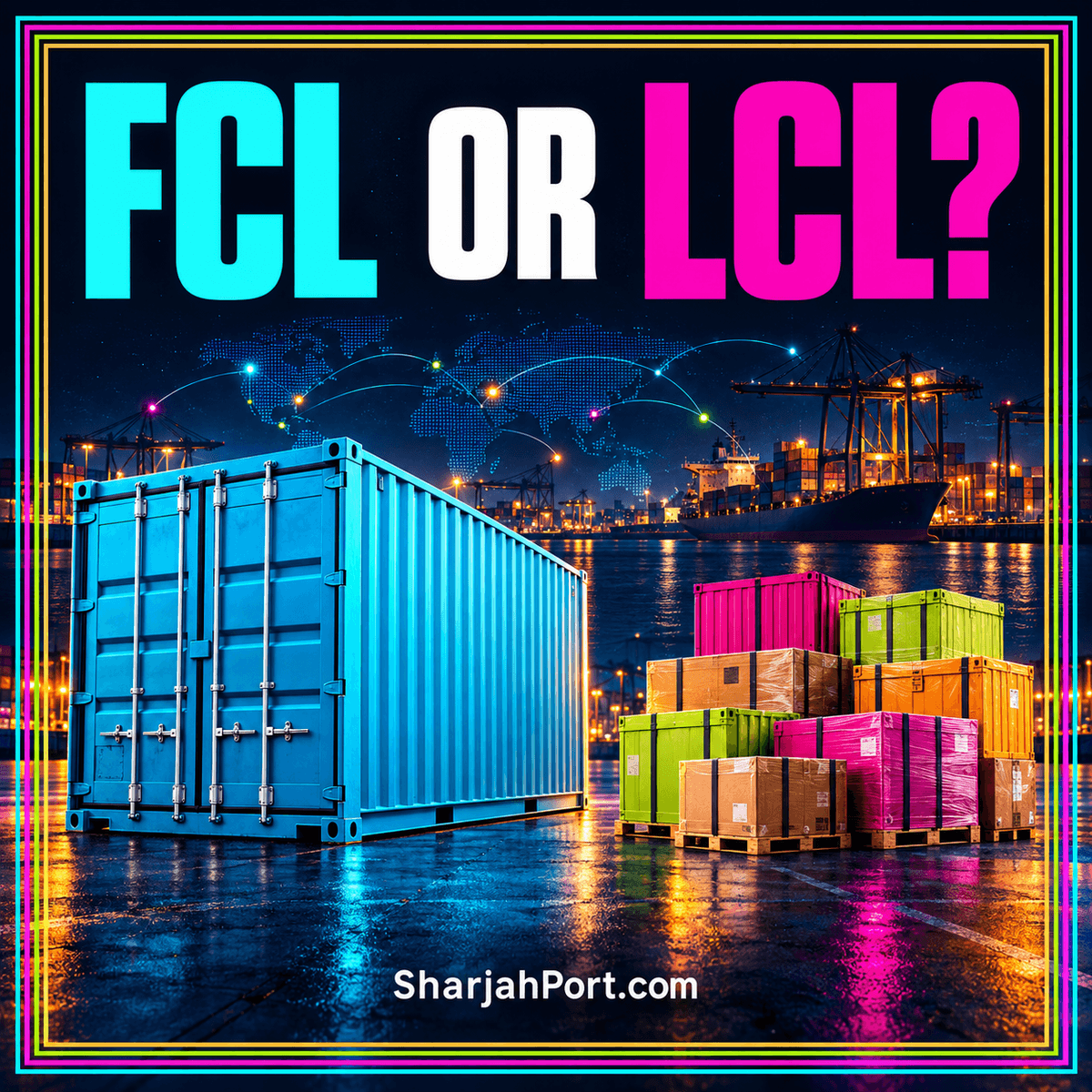
FCL means full container load. The booking gives the shipment dedicated use of a container, even when the goods do not fill every available space. LCL means less than container load: a consolidator combines separate consignments in one container and separates them for onward delivery.
Maersk's explanation of FCL and LCL shipping sets out these basic service differences. Treat general size guidelines as a starting point. The right choice depends on the particular packing configuration, route, charge basis, and service offered for your consignment.
A dedicated container does not guarantee an uninterrupted journey or eliminate inspection. Shared space does not mean an unsuitable service. Ask how the provider will execute each option, including where cargo changes custody and when it becomes available for collection.
Measure the packed shipment first
Obtain the dimensions and gross weight of every shipping unit after packing. Use the outer dimensions of the pallet, crate, or carton, including overhang. Record which units can be stacked, which must remain upright, and which need lifting points or handling equipment.
For LCL, this information allows the provider to assess the space and handling required. For FCL, it supports a real loading plan. A volume calculation alone cannot show whether a long crate fits through the container doors or whether a heavy machine places an unacceptable load on the floor. Have the packer and equipment provider confirm feasibility before comparing prices.
Keep product weight separate from packed weight. A supplier's catalogue entry rarely accounts for export crates, pallets, protective material, and the final packing arrangement.
Compare the same beginning and end
One quotation may start at the supplier's premises and finish at your warehouse. Another may begin at an origin consolidation facility and end when cargo is available at a destination freight station. The cheaper headline could simply cover fewer tasks.
Give both bidders identical collection and delivery addresses, cargo details, and the required delivery window. Ask them to identify the loading port, discharge terminal, consolidation facilities where relevant, and all inland legs. State whether your team needs unloading, pallet movement, or a truck with particular equipment.
Review the complete offer using our guide to comparing Sharjah freight costs. A useful comparison captures origin handling, ocean carriage, destination handling, documentation, delivery, and any stated exclusions. Separate fixed charges from charges triggered by waiting, inspection, storage, or a changed instruction.
Ask how chargeable quantity is determined
For LCL, ask the provider to state the calculation used for chargeable weight or volume, any minimum charge, and how measurements will be checked. Heavy compact goods and light bulky goods create different commercial questions. A label showing cubic metres does not explain the whole tariff.
For FCL, confirm the equipment type, permitted cargo weight for the planned movement, included services, and whether special loading or delivery conditions change the quotation. Request the price using your actual shipment details rather than a generic container description.
There is no universal volume at which FCL becomes cheaper. Compare two valid offers for the same shipment, including the receiving operation. Recheck the choice when quantities, packaging, or route change.
Build a delivery timeline around cargo availability
A vessel's estimated arrival is one event in a longer sequence. Your planning date should reflect when the goods can be received and used. Ask for the expected steps from collection through export processing, sailing, arrival, release, and delivery.
For LCL, identify the consolidation closing date and the destination separation process. Ask when an individual consignment becomes available, who announces availability, and what documents the receiver needs. For FCL, establish how a released container will be collected, unloaded, and returned.
Compare the offered itineraries rather than assuming that one service label always means a faster delivery. A practical proposal should explain the principal dependencies and the next action if a connection or receiving appointment changes. Avoid making production commitments from a sailing estimate alone.
Consider the cargo's tolerance for handling
Make the handling discussion specific. Glass panels, calibrated equipment, machine components, and ordinary boxed stock do not present identical requirements. Show the provider photographs, packing drawings, and any manufacturer's handling instructions before booking.
With LCL, ask how the consignment will be handled at each freight station and what stacking or cargo compatibility restrictions apply. With FCL, ask who designs and checks the securing arrangement. Dedicated space still requires suitable packaging and restraint.
Describe moisture sensitivity, odour sensitivity, hazardous characteristics, and any temperature requirements accurately. A request marked simply as general cargo can conceal an issue that the provider needed to assess. Obtain explicit acceptance for special cargo and check the insurance conditions for the proposed packing and route.
Test the destination operation
Before selecting FCL, ask the warehouse manager how the container will be unloaded. Confirm access for the vehicle, space to position it, safe equipment, available staff, and the appointment process. Check whether unloading occurs while the truck waits or under another agreed arrangement.
LCL may arrive as pallets or crates on a local delivery vehicle, but the receiver still needs an agreed unloading method. Do not assume a tail lift, forklift, or delivery inside the premises is included. The dispatch instruction should identify the responsible party for each action.
Use the shipping to Sharjah checklist to align the cargo details, documents, and receiving contact before the goods depart.
Work through two contrasting orders
Consider a distributor testing a new product range. The first order consists of a few well packed pallets, demand is uncertain, and the warehouse has limited spare space. An LCL proposal may support a smaller buying commitment. The distributor should examine the complete destination charges and cargo availability date before accepting that advantage.
Now consider a manufacturer buying a larger batch of components that will be consumed on a known production plan. A dedicated container may simplify the loading arrangement and scheduled receipt. The manufacturer still needs to verify that the batch can be secured properly and unloaded within the agreed operating plan.
Neither example establishes a price threshold. The comparison changes if the distributor's cartons are non-stackable, the manufacturer's goods exceed practical weight limits, or either shipment has a different itinerary. The decision follows the actual constraints.
Include inventory in the conversation
Buying more goods to fill a container can reduce the apparent transport cost per item while increasing the cash committed to stock. It can also create storage pressure or leave slow moving products in the warehouse. Ask purchasing and operations to review the same proposal.
Conversely, ordering very small batches may create repeated handling and administration costs. Compare a realistic replenishment pattern over several shipments. Keep the freight calculation distinct from the inventory assumptions so that you can see which factor drives the decision.
Record the reorder trigger as well as the shipment size. If sales accelerate, decide what change would justify requesting an FCL comparison again. If demand slows, identify whether the next order can be reduced without creating a stock shortage. This connects the freight decision to a purchasing action your team can revisit.
Record why the chosen option works
Finish with a short booking record: cargo version, selected service, total quoted scope, principal exclusions, required delivery outcome, and who owns the next steps. Include the loading plan for FCL or the accepted packing and handling details for LCL.
Arrange the inland movement alongside the ocean booking using the sea and road logistics planning guide. Revisit the choice after delivery by comparing the estimate with actual handling, timing, and charges. That shipment record gives the next purchasing decision a stronger basis than a general rule about container size.